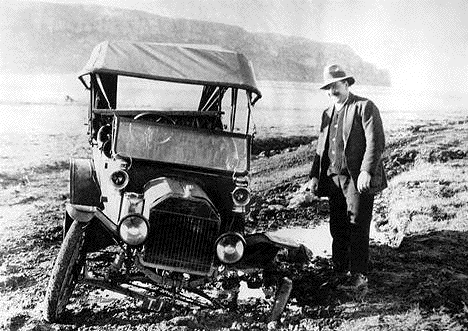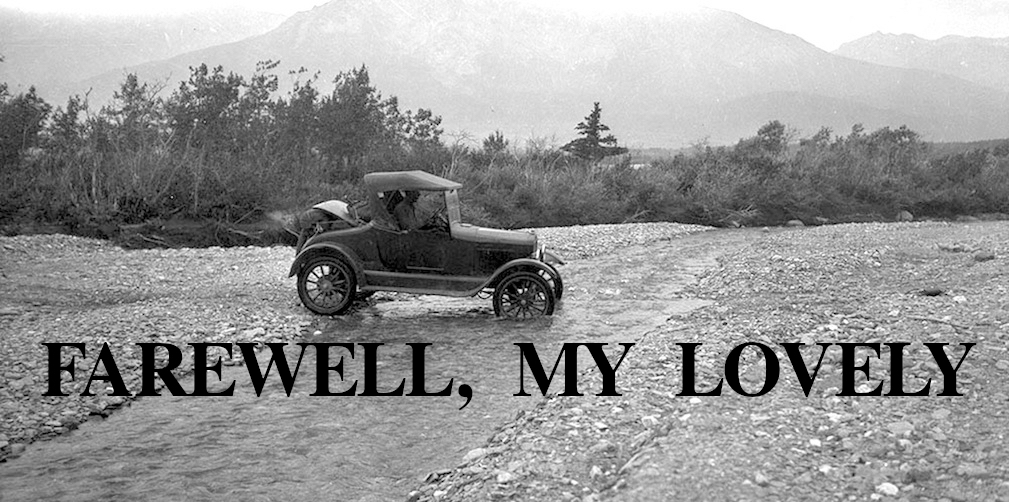
| I see by the new Sears Roebuck catalogue that it is still possible to buy an axle for a 1909 Model T Ford, but I am not deceived. The great days have faded, and the end is in sight. Only one page in the current catalogue is devoted to parts and accessories for the Model T; yet everyone remembers springtimes when the Ford gadget section was larger than men's clothing, almost as large as household furnishings. The last Model T was built in 1927, and the car is fading from what scholars call the American scene - which is an understatement, because to a few million people who grew up with it, the old Ford practically was the American scene. It was the miracle that God had wrought. And it was patently the sort of thing that could only happen once. Mechanically uncanny, it was like nothing that had ever come to the world before. Flourishing industries rose and fell with it. As a vehicle, it was hard working, commonplace, heroic; and it often seemed to transmit those qualities to the person who rode in it. My own generation identifies it with Youth, with its gaudy, irretrievable excitements; before it fades into the mist, I would like to pay it the tribute of the sigh that is not a sob, and set down random entries in a shape somewhat less cumbersome than a Sears Roebuck catalogue. |
 |
|
The Model T was distinguished from all other makes of cars by the fact that its transmission was of a type known as planetary - which was half metaphysics, half sheer fiction. Engineers accepted the word 'planetary' in its epicyclic sense, but I was always conscious that it also meant 'wandering', 'erratic'. Because of the peculiar nature of this planetary element, there was always, in Model T, a certain dull rapport between engine and wheels, and even when the car was in a state known as neutral, it trembled with a deep imperative and tended to inch forward. There was never a moment when the bands were not faintly egging the machine on. In this respect it was like a horse, rolling the bit on its tongue, and country people brought to it the same technique they used with draft animals. Its most remarkable quality was its rate of acceleration. In its palmy days the Model T could take off faster than anything on the road. The reason was simple. To get under way, you simply hooked the third finger of the right hand around a lever on the steering column, pulled down hard, and shoved your left foot forcibly against the low-speed pedal. These were simple, positive motions the car responded by lunging forward with a roar. After a few seconds of this turmoil, you took your toe off the pedal, eased up a mite on the throttle, and the car, possessed of only two forward speeds, catapulted directly into high with a series of ugly jerks and was off on its glorious errand. The abruptness of this departure was never equaled in other cars of the period. The human leg was (and still is) incapable of letting in the clutch with anything like the forthright abandon that used to send Model T on its way. Letting in a clutch is a negative, hesitant motion, depending on delicate nervous control; pushing down the Ford pedal was a simple, country motion - an expansive act, which came as natural as kicking an old door to make it budge. |
|
|
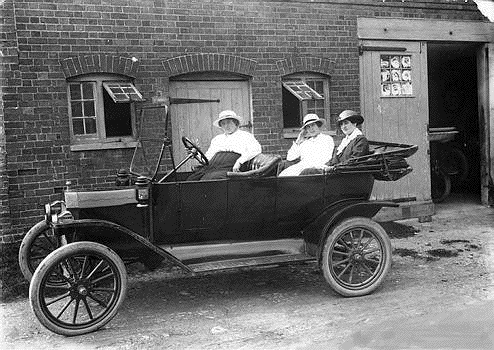
The driver of the old Model T was a man enthroned. The car, with top up, stood seven feet high. The driver sat on top of the gas tank, brooding it with his own body. When he wanted gasoline, he alighted, together with everything else in the front seat; the seat was pulled off, the metal cap unscrewed, and a wooden stick thrust down to sound the liquid in the well. There was always a couple of these sounding sticks kicking around in the ratty sub-cushion regions of a flivver. Refueling was more of a social function then, because the driver had to unbend, whether he wanted to or not. Directly in front of the driver was the windshield - high, uncompromisingly erect. Nobody talked about air resistance, and the four cylinders pushed the car through the atmosphere with a simple disregard of physical law. There was this about a Model T; the purchaser never regarded his purchase as a complete, finished product. When you bought a Ford, you figured you had a start - a vibrant, spirited framework to which could be screwed an almost limitless assortment of decorative and functional hardware. Driving away from the agency, hugging the new wheel between your knees, you were already full of creative worry. A Ford was born naked as a baby, and a flourishing industry grew up out of correcting its rare deficiencies and combating its fascinating diseases. Those were the great days of lily-painting. I have been looking at some old Sears Roebuck catalogues, and they bring everything back so clear. |
 |
First you bought a Ruby Safety Reflector for
the rear, so that your posterior would glow in another
car's brilliance. Then you invested thirty-nine cents in
some radiator Moto Wings, a popular ornament which gave
the Pegasus touch to the machine and did something
godlike to the owner. For nine cents you bought a
fan-belt guide to keep the belt from slipping off the
pulley. You bought a radiator compound to stop leaks.
This was as much a part of everybody's equipment as
aspirin tablets are of a medicine cabinet. You bought
special oil to stop chattering, a clamp-on dash light, a
patching outfit, a tool box which you bolted on the
running board, a sun visor, a steering-column brace to
keep the column rigid, and a set of emergency containers
for gas, oil and water - three thin, disc-like cans
which reposed in a case on the running board during
long, important journeys - red for gas, gray for water,
green for oil. It was only a beginning. After the car
was about a year old, steps were taken to check the
alarming disintegration. (Model T was full of tumors,
but they were benign.) A set of anti-rattlers
(ninety-eight cents) was a popular panacea. You hooked
them on to the gas and spark rods, to the brake pull
rod, and to the steering-rod connections. Hood
silencers, of black rubber, were applied to the
fluttering hood. Shock absorbers and snubbers gave
'complete relaxation'. Some people bought rubber pedal
pads, to fit over the standard metal pedals. (I didn't
like these, I remember.) Persons of a suspicious or
pugnacious turn of mind bought a rear-view mirror; but
most Model T owners weren't worried by what was coming
from behind because they would soon enough see it out in
front. They rode in a state of cheerful catalepsy. Quite
a large mutinous clique among Ford owners went over to a
foot accelerator (you could buy one and screw it to the
floor board), but there was a certain madness in these
people, because the Model T, just as she stood, had a
choice of three foot pedals to push, and there were
plenty of moments when both feet were occupied in the
routine performance of duty and when the only way to
speed up the engine was with the hand throttle.
Gadget bred gadget. Owners not only bought ready-made gadgets, they invented gadgets to meet special needs. I myself drove my car directly from the agency to the blacksmith's, and had the smith affix two enormous iron brackets to the port running board to support an army trunk. |
|
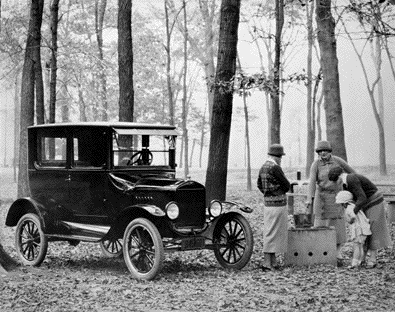
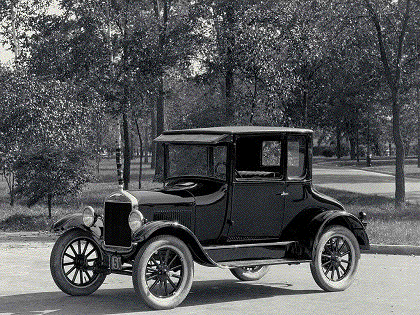
People who owned closed models builded along different lines: they bought ball grip handles for opening doors, window anti-rattlers, and de-luxe flower vases of the cut-glass anti-splash type. People with delicate sensibilities garnished their car with a device called the Donna Lee Automobile Disseminator - a porous vase guaranteed, according to Sears, to fill the car with 'la faint clean odor of lavender'. The gap between open cars and closed cars was not as great then as it is now: for $11.95, Sears Roebuck converted your touring car into a sedan and you went forth renewed. One agreeable quality of the old Fords was that they had no bumpers, and their fenders softened and wilted with the years and permitted the driver to squeeze in and out of tight places. Tires were 30 x 3½, cost about twelve dollars, and punctured readily. Everybody carried a Jiffy patching set, with a nutmeg grater to roughen the tube before the goo was spread on. Everybody was capable of putting on a patch, expected to have to, and did have to. |
 |
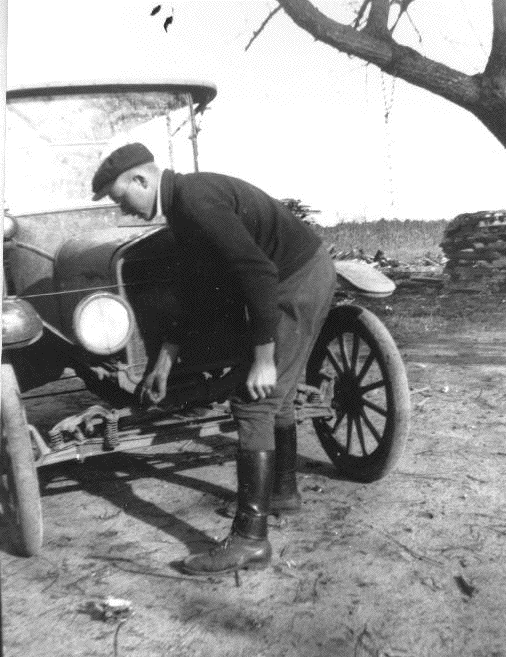
During my association with Model T's, self-starters were not a prevalent accessory. They were expensive and under suspicion. Your car came equipped with a serviceable crank, and the first thing you learned was how to Get Results. It was a special trick, and until you learned it (usually from another Ford owner, but sometimes by a period of appalling experimentation) you might as well have been winding up an awning. The trick was to leave the ignition switch off, proceed to the animal's head, pull the choke (which was a little wire protruding through the radiator) and give the crank two or three nonchalant upward lifts. Then, whistling as though thinking about something else, you would saunter back to the driver's cabin, turn the ignition on, return to the crank, and this time, catching it on the downstroke, give it a quick spin with plenty of That. If this procedure was followed, the engine almost always responded - first with a few scattered explosions, then with a tumultuous gunfire, which you checked by racing around to the driver's seat and retarding the throttle. Often, if the emergency brake hadn't been pulled all the way back, the car advanced on you the instant the first explosion occurred and you would hold it back by leaning your weight against it. I can still feel my old Ford nuzzling me at the curb, as though looking for an apple in my pocket. In zero weather, ordinary cranking became an impossibility, except for giants. The oil thickened, and it became necessary to jack up the rear wheels, which for some planetary reason, eased the throw. |
| The lore and legend that governed the Ford were boundless. Owners had their own theories about everything; they discussed mutual problems in that wise, infinitely resourceful way old women discuss rheumatism. Exact knowledge was pretty scarce, and often proved less effective than superstition. Dropping a camphor ball into the gas tank was a popular expedient; it seemed to have a tonic effect both on man and machine. There wasn't much to base exact knowledge on. The Ford driver flew blind. He didn't know the temperature of his engine, the speed of his car, the amount of his fuel, or the pressure of his oil (the old Ford lubricated itself by what was amiably described as the 'splash system'). A speedometer cost money and was an extra, like a windshield-wiper. The dashboard of the early models was bare save for an ignition key; later models, grown effete, boasted an ammeter which pulsated alarmingly with the throbbing of the car. Under the dash was a box of coils, with vibrators which you adjusted, or thought you adjusted. Whatever the driver learned of his motor, he learned not through instruments but through sudden developments. I remember that the timer was one of the vital organs about which there was ample doctrine. When everything else had been checked, you had a look at the timer. It was an extravagantly odd little device, simple in construction, mysterious in function. It contained a roller, held by a spring, and there were four contact points on the inside of the case against which, many people believed, the roller rolled. I have had a timer apart on a sick Ford many times. But I never really knew what I was up to, I was just showing off before God. There were almost as many schools of thought as there were timers. Some people, when things went wrong, just clenched their teeth and gave the timer a smart crack with a wrench. Other people opened it up and blew on it. There was a school that held that the timer needed large amounts of oil; they fixed it by frequent baptism. And there was a school that was positive it was meant to run dry as a bone; these people were continually taking it off and wiping it. I remember once spitting into a timer; not in anger, but in a spirit of research. You see, the Model T driver moved in the realm of metaphysics. He believed his car could be hexed. |
|
One reason the Ford anatomy was never reduced to an exact science was that, having 'fixed' it, the owner couldn't honestly claim that the treatment had brought about the cure. There were too many authenticated cases of Fords fixing themselves - restored naturally to health after a short rest. Farmers soon discovered this, and it fitted nicely with their draft-horse philosophy: 'Let 'er cool off and she'll snap into it again.' A Ford owner had Number One Bearing constantly in mind. This bearing, being at the front end of the motor, was the one that always burned out, because the oil didn't reach it when the car was climbing hills. (That's what I was always told, anyway.) The oil used to recede and leave Number One dry as a clam flat; you had to watch that bearing like a hawk. It was like a weak heart - you could hear it start knocking, and that was when you stopped to let her cool off. Try as you would to keep the oil supply right, in the end Number One always went out. 'Number One Bearing burned out on me and I had to have her replaced,' you would say, wisely; and your companions always had a lot to tell about how to protect and pamper Number One to keep her alive. |
 |
 |
Sprinkled not too
liberally among the millions of amateur witch doctors
who drove Fords and applied their own abominable cures
were the heaven sent mechanics who could really make
the car talk. These professionals turned up in
undreamed-of spots. One time, on the banks of the
Columbia River in Washington, I heard the rear end go
out of my Model T when I was trying to whip it up a
steep incline onto the deck of a ferry. Something
snapped; the car slid backwards into the mud. It
seemed to me like the end of the trail. But the
captain of the ferry, observing the withered remnant,
spoke up.
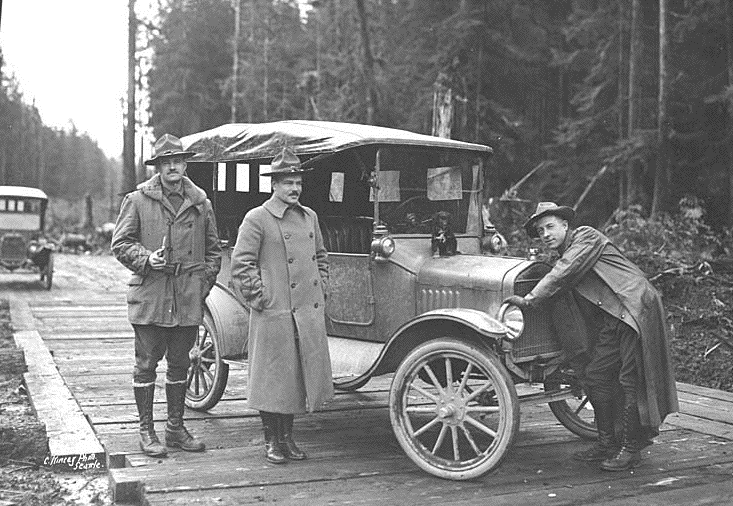
'What's got her?' he asked. 'I guess it's the rear end,' I replied listlessly. The captain leaned over the rail and stared. Then I saw that there was a hunger in his eyes that set him off from other men. 'Tell you what,' he said casually, trying to cover up his eagerness, 'let's pull the son of a bitch up onto the boat, and I'll help you fix her while we're going back and forth on the river.' We did just this. All that day I plied between the towns of Pasco and Kenniwick, while the skipper (who had once worked in a Ford garage) directed the amazing work of resetting the bones of my car. |
|
Springtime in the heyday of the Model T was a delirious season. Owning a car was still a major excitement, roads were still wonderful and bad. The Fords were obviously conceived in madness: any car which was capable of going from forward into reverse without any perceptible mechanical hiatus was bound to be a mighty challenging thing to the human imagination. Boys used to veer them off the highway into a level pasture and run wild with them, as though they were cutting up with a girl. Most everybody used the reverse pedal quite as much as the regular foot brake - it distributed the wear over the bands and wore them all down evenly. That was the big trick, to wear all the bands down evenly, so that the final chattering would be total and the whole unit scream for renewal. The days were golden, the nights were dim and strange. I still recall with trembling those loud, nocturnal crises when you drew up to a signpost and raced the engine so the lights would be bright enough to read destinations by. I have never been really planetary since. I suppose it's time to say goodbye. Farewell, my lovely! |